High Yield, Growth or Balance: How to Choose the Right Property Investment Strategy

Not every property investment is designed to achieve the same outcome.
Some opportunities are structured to maximise current income. Others prioritise long-term capital growth, while a third category aims to combine dependable rental returns with the potential for asset appreciation.
The most suitable strategy depends on your objectives, budget, time horizon and preferred level of involvement. For an experienced professional, the question is not simply whether a property offers a high yield. It is whether the opportunity fits the wider purpose of your portfolio.
In this guide, we examine three core approaches to UK property investment:
Maximising income through specialist accommodation and short-term letting
Building a balanced investment across income, location and flexibility
Following a traditional buy-to-let strategy focused on steady rent and long-term growth
Start with the objective, not the property
Property investment decisions are often made by comparing headline yields. That is understandable, but it can lead to an incomplete assessment.
A property offering a higher potential return may involve more active management, greater exposure to occupancy levels or increased operational costs. Conversely, a traditional buy to let in an established market may provide a lower initial yield but offer a more familiar management model and stronger long-term capital growth prospects.
The first step is therefore to decide what you want the investment to do.
Do you want to maximise monthly or annual income?
Are you primarily focused on long-term wealth creation?
Would you prefer a combination of income, growth and manageable risk?
How involved do you want to be in the day-to-day operation?
Are you investing for personal income, portfolio expansion or intergenerational wealth?
There is no universally correct answer. The right strategy is the one that aligns with your financial objectives.

Strategy one: Maximise income
An income-focused strategy is designed to produce stronger potential rental returns, often through specialist accommodation models rather than a conventional single-family rental.
This may include:
Aparthotel units
Serviced accommodation
Purpose-built student accommodation (PBSA)
Professionally managed short-term rentals
Selective Airbnb investment opportunities in established visitor or business locations
These models can achieve higher potential net yields because income is generated through a combination of nightly, weekly or room-based pricing rather than a single annual tenancy agreement.
Who does a high-income strategy suit?
A high-yield approach may suit investors who:
Want to prioritise cash flow
Have a higher tolerance for operational risk
Are comfortable investing in specialist accommodation
Prefer a managed model but understand that performance depends on occupancy and demand
Are seeking to increase portfolio income or reinvest rental profits
It can be particularly relevant to investors who want their capital to work harder in the shorter to medium term. However, higher potential income should not be confused with guaranteed income.
Yield expectations and risk profile
Traditional UK buy-to-let properties in established markets may commonly produce gross yields in the mid-single digits, although this varies considerably by location, property type, financing and purchase price.
Specialist accommodation can potentially achieve higher figures. For example, current opportunities presented by Residential Estates include advertised net yields of 10.5% on a PBSA investment and 15% on an aparthotel opportunity. These figures relate to specific properties and structures, and investors should always review the underlying assumptions, management arrangements, costs and availability before proceeding.
The central distinction is between gross and net yield. Net yield should account for relevant operating expenses, management charges, maintenance, utilities, insurance, voids and other costs. A high headline return is only useful if it remains sustainable after these deductions.
The risk profile is also different. Short-term rentals and serviced accommodation can be exposed to seasonality, local regulation, changing travel patterns and fluctuating occupancy. PBSA may benefit from recurring demand in strong university locations, but it remains linked to student numbers, local supply and the quality of the management structure.
Level of involvement
A specialist accommodation strategy can be operationally intensive if managed directly. It may involve:
Guest communication
Cleaning and changeovers
Dynamic pricing
Maintenance coordination
Platform management
Compliance and safety procedures
For investors seeking a more hands-off approach, professional management is an important consideration. A capable operator can manage the daily process while providing reporting and oversight, allowing the investor to access a specialist model without personally running the accommodation business.

Strategy two: Build a balanced investment
A balanced strategy aims to combine attractive income with established locations, credible demand drivers and a sustainable management model.
Rather than pursuing the highest possible yield or relying exclusively on capital appreciation, balanced investing considers the total return and resilience of the opportunity.
A balanced property might offer:
A competitive rental yield
An established residential or employment market
Multiple potential tenant groups
Long-term regeneration or infrastructure support
A location with both rental and resale demand
A management model that limits day-to-day involvement
This approach may include a quality residential buy-to-let, a PBSA unit in a proven university city, or a combination of residential and serviced accommodation across a broader portfolio.
Who does a balanced strategy suit?
This is often the most suitable approach for investors who:
Want income and growth rather than one at the expense of the other
Are building a diversified property portfolio
Prefer moderate risk
Want to avoid excessive concentration in one letting model or location
Are investing over a medium to long-term horizon
For many investors, a balanced approach offers a practical middle path. It recognises that income supports portfolio sustainability today, while location and asset quality can contribute to future capital growth.
Yield expectations and risk profile
Balanced opportunities may offer yields in the mid-single digits, although the exact figure depends on the property, location and investment structure. The priority is not necessarily to achieve the highest yield available, but to secure a reasonable income return alongside durable demand and long-term potential.
For example, a residential BTL in a strong regional location may provide a blend of rental income and capital growth. A specialist asset could then be included elsewhere in the portfolio to enhance income, rather than making the entire portfolio dependent on short-term occupancy.
Diversification can reduce reliance on a single source of return. Different tenant groups, regions and letting strategies may respond differently to economic conditions. This does not eliminate risk, but it can make the overall portfolio more resilient.
Aparthotel versus buy to let: where does balance fit?
The question of aparthotel vs buy to let is not always a matter of choosing one model permanently.
A traditional buy to let may provide a relatively familiar long-term tenancy structure, while an aparthotel or serviced apartment may offer stronger income potential with more operational complexity. A balanced portfolio may use both, provided the investor understands how each asset contributes to the overall plan.
Residential Estates’ comparison of aparthotels and standard buy-to-lets explores these differences in more detail.

Strategy three: Traditional buy-to-let
Traditional buy-to-let remains a central component of UK property investment.
The model is straightforward: acquire a residential property, let it to tenants on a long-term basis and seek to benefit from ongoing rental income and potential capital appreciation over time.
While the market has become more complex, the fundamental rationale remains familiar. Quality housing in locations with sustained employment, transport links, education and amenities can continue to attract tenant demand over the long term.
Who does a traditional BTL strategy suit?
Traditional buy to let may suit investors who:
Have a long investment horizon
Prioritise asset appreciation as well as rental income
Prefer a more established letting model
Want exposure to the residential rental market
Are prepared to accept a lower initial yield in exchange for potential growth
Prefer longer-term tenants and less frequent property turnover
This approach can be suitable for investors building a portfolio gradually and those who are less reliant on immediate maximum income.
Yield expectations and risk profile
Traditional BTL yields vary widely across the UK. Regional markets may offer stronger initial rental returns, while higher-value areas can produce lower yields but may offer different capital growth characteristics.
The principal return sources are:
Rent received from tenants
Potential increases in rental value
Long-term capital appreciation
Mortgage capital repayment, where applicable
However, investors must allow for mortgage costs, maintenance, insurance, management fees, void periods and taxation. As explained in Residential Estates’ guide to yield, ROI and cash flow, a property can show a reasonable yield while producing limited cash flow once all costs have been accounted for.
The risk profile is generally more familiar than that of short-term accommodation, but it is not risk-free. Interest rates, regulation, tenant affordability, maintenance and local supply can all affect performance.
Level of involvement
A long-term BTL can be relatively straightforward to operate, particularly when managed professionally. Nevertheless, landlords remain responsible for compliance, tenant communication, repairs, inspections and financial administration unless these duties are delegated.
Professional management can help protect the asset, support tenant retention and reduce the administrative burden. It can also provide a more consistent experience for investors who are based overseas, have multiple properties or simply prefer not to be involved in daily operations.
How to match your objectives to the right opportunity
A practical way to assess your options is to consider the following three investor profiles.
If your priority is income
Focus on potential net yield, occupancy assumptions, operating costs and management quality. Specialist accommodation, PBSA and carefully selected short-term rental models may be relevant.
Do not assess the opportunity on yield alone. Stress-test the figures for lower occupancy, higher costs and changes in demand.
If your priority is growth
Focus on location, supply constraints, employment, infrastructure, population trends and resale demand. A traditional BTL in an established or regenerating market may be appropriate, even if its initial yield is less prominent.
Capital growth is never guaranteed, so the investment should still be assessed for rental sustainability.
If you want balance
Consider combining property types, locations or letting strategies. A portfolio might include traditional residential BTL for stability, specialist accommodation for enhanced income and assets in locations with credible long-term growth drivers.
The appropriate mix will depend on your available capital, borrowing position, tax circumstances, time horizon and capacity to absorb short-term volatility.
The value of a full property cycle partner
The most effective strategy can still underperform if the purchase, letting and management process is not properly coordinated.
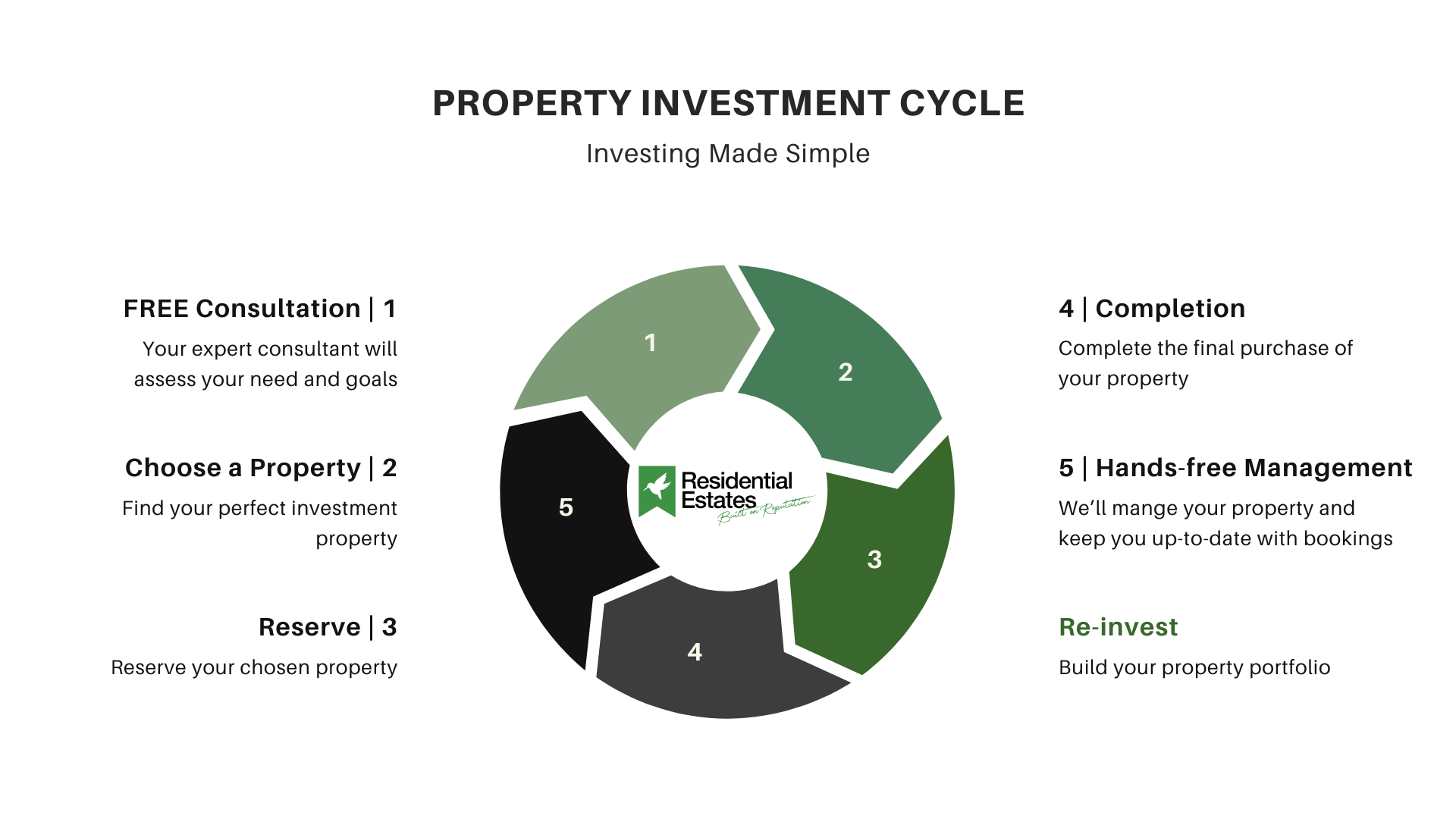
Residential Estates provides support across the complete property cycle: invest, buy, rent and stay. This includes access to property investment opportunities, acquisition support, residential sales and lettings, serviced accommodation and comprehensive management for both long-term and short-term models.
With decades of combined team experience and a focus on exceptional customer service, Residential Estates helps investors assess opportunities with a longer-term perspective. The objective is not simply to present a list of properties, but to identify investments that are appropriate for the individual investor.
An Investment Consultant can consider your:
Budget and preferred funding structure
Income and growth objectives
Target returns
Preferred level of involvement
Appetite for operational and market risk
Existing portfolio and diversification needs
The result is a more considered property shortlist, rather than a generic recommendation.
Conclusion: choose the strategy that fits the plan
High yield, growth and balance each have a legitimate place within UK property investment.
A specialist accommodation or Airbnb investment may appeal to those prioritising income and accepting greater operational complexity. Traditional buy to let may suit long-term investors seeking steady rent and potential capital growth in established markets. A balanced approach can combine the two, creating a portfolio designed to remain resilient across changing market conditions.
The most important decision is not selecting the strategy currently receiving the most attention. It is understanding what you want your capital to achieve and choosing an opportunity that supports that objective.
To explore current property investment opportunities or arrange a conversation with an Investment Consultant, book a consultation with Residential Estates.
Our team can help you compare income-focused, balanced and traditional buy-to-let options according to your budget, objectives and preferred level of involvement.