

The popular narrative presents short-term let regulation as a threat to the whole sector. For a long-term investor, that is too broad a conclusion. Regulation does bring additional cost and work; however, it can also act as a supply constraint. When compliance becomes more demanding, casual or marginal operators may decide the business is no longer viable. Professionally run accommodation may then face less competition for the same guest demand.
That is a possibility, not a guaranteed outcome. The detail differs by location and property type, and enforcement remains uneven. The practical question for an investor is not whether regulation matters, but which requirements apply to a particular asset, who will handle them and how they affect the numbers.
Three regulatory layers to distinguish
1. Rental reform and landlord administration
The Renters’ Rights Act is already in force and has increased landlord compliance obligations. The separate PRS Database goes live on 15 December 2026. It costs £65 per property per year, with a three-month registration window for each English region.
These are relevant to the wider rental market, but should not be confused with England’s planned short-term let register. The rules that apply depend on the property and how it is operated. For more background, see our guide to the Renters’ Rights Act. Meanwhile, Making Tax Digital for Income Tax is phasing in, adding another reason to keep property and financial records organised.
2. Registration requirements
In England, a short-term let registration scheme is expected to begin in March 2027, but final regulations have not yet been published. Investors should therefore treat the date as an expected start, not assume that every detail, including the final operating requirements, is already settled. Registration is distinct from planning permission and does not, by itself, establish that a property’s use is permitted.
Wales has a separate visitor accommodation registration scheme already open, with a deadline of 31 March 2027. Scotland’s rules also differ from England’s. Investors should check the relevant national and local requirements rather than relying on a single UK-wide interpretation.
3. Planning and use class
Planning restrictions can apply independently of registration. In Greater London, the 90-night rule limits short-term letting of an entire home to 90 nights per calendar year without planning permission. It is a London rule, not a national cap. Local Article 4 Directions can also remove permitted development rights.
In Scotland’s Highland short-term let control areas, Inverness City and Highland Rural, planning permission will be required for new secondary short-term lets from 1 April 2027. The areas were approved in November 2026; the change is not retrospective to existing operators.
C5 is often discussed in relation to short-term letting, but should not be assumed to be an England-wide use class in force. The planning position needs to be checked for the individual property. A scheme such as Windermere Park, for example, is described as C1 commercial use and strictly non-residential; that specific status should not be generalised to other assets.

How regulation can affect yield
Regulation affects yield through both sides of the equation: operating costs and available supply.
On costs, registration fees, record-keeping, planning checks and professional support can reduce net income. These should be included in an investor’s assessment, not treated as incidental. On supply, additional fixed costs and administration can make some properties uneconomic to operate. If that reduces the number of active, compliant operators in a location, the remaining quality accommodation may have less direct competition.
This is one reason professionalisation matters. The serviced accommodation sector has been projected to reach £6.52bn by 2033, at around 8.8% CAGR. Market and industry figures have also cited roughly 7–10% net yields for serviced accommodation and aparthotel models, compared with around 3.5–5% for standard buy-to-let. These are broad market figures, not guarantees; actual performance depends on the asset, local demand, costs and operator.
For context, more than 45% of UK buy-to-let is now held through companies. That shift reflects a market in which many investors are formalising their ownership and operating arrangements. Regulation may accelerate that professionalisation, although it does not ensure that every professionally run property will outperform.
Who carries the workload?
A self-managed holiday let owner may coordinate registrations, local planning checks, guest communications, bookings, maintenance and record-keeping personally. A managed aparthotel can centralise many of these operational tasks with an experienced operator. That can make compliance more organised, but it does not automatically transfer every legal obligation from owner to operator. Responsibilities should be confirmed in the contracts and checked against the property’s circumstances.
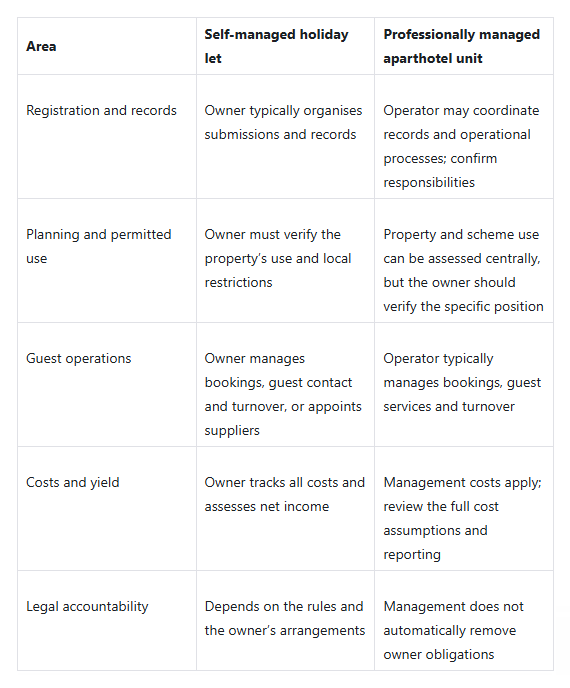
In practical terms, a professionally managed unit may reduce the administrative burden on an individual owner, but the investor still needs to understand what is included, what is charged and what remains their responsibility. Residential Estates’ property management team works across long- and short-term accommodation, while its linked Guestz brand provides guest-facing serviced accommodation.
An illustrative yield, not a promise
Windermere Park provides an example of how assumptions shape a yield calculation. On a £70,000 entry unit, a projected nightly rate of £85 across 270 occupied nights (74% occupancy) produces £22,950 gross income, equivalent to a 32.8% gross yield.
After an assumed 48% in Variable Costs, the illustrative net yield is 17.1%. This is a projection based on the stated assumptions, not a guaranteed return or a prediction for other properties. Changes in occupancy, achieved nightly rate or costs would change the result. Windermere Park comprises 23 boutique hotel studios, has a 999-year lease and no ground rent; its C1 use is described as strictly non-residential. The development sold out within about 48 hours of its 5 November launch. Lakeside House in Keswick has also sold out.
The risks should not be minimised
Registration and planning changes can bring real cost and uncertainty. England’s final short-term let regulations have not yet been published, and enforcement remains uneven. Local planning restrictions can materially affect a property’s permitted use. Demand, occupancy and nightly rates can also vary, while an operator’s performance and contract terms matter to the owner’s net return.
Not every property is suitable for serviced accommodation, and an aparthotel label alone is not evidence of regulatory compliance or strong performance. Due diligence should cover use, lease terms, planning, insurance, finance, management responsibilities and the assumptions behind any yield projection.

A practical checklist for 2027
Before buying or repositioning a short-term let, consider:
Identify the relevant rules: check the nation, local authority and property type.
Separate registration from planning: one does not automatically resolve the other.
Confirm the permitted use: review planning records, lease provisions and any local restrictions.
Check the operating arrangements: ask who handles registration, records, safety processes and guest operations, and what remains your responsibility.
Test the figures: review nightly rate, occupancy and every cost included in the projected net yield.
Allow for change: where final regulations are pending, understand which assumptions may need to be revisited.
A measured view of the opportunity
Regulation matters in 2027, but it is not a single national restriction and does not make every short-term let strategy unviable. It raises the value of clear records, suitable property use and capable management. For the experienced investor, the long-term question is whether the asset can operate compliantly and sustainably, not whether a headline predicts a collapse.
With no new launches scheduled until mid-January, investors can review the current property selection and discuss the operating model, costs and available management support with Residential Estates and Guestz. Call 01244 343 355 or email sales@residential-estates.co.uk.
Frequently asked questions
-
An England short-term let registration scheme is expected to begin in March 2027, but final regulations have not yet been published. Investors should check the final requirements when they are available and assess registration separately from planning permission.
-
No. The 90-night rule applies to short-term letting of an entire home in Greater London without planning permission. It is a London rule, not a national cap.
-
No. A stated C1 commercial use may be relevant to a particular property, but investors should still check planning, lease, registration, insurance and operating requirements. C5 should not be assumed to be an England-wide use class in force.
-
No. Management can help organise day-to-day operations, but it does not guarantee occupancy, nightly rates or returns. Review the property’s projections, costs, management terms and responsibilities before investing.
-
Check the property’s permitted use, local planning restrictions, applicable registration rules, lease and finance terms, management responsibilities and projected costs. Assess the yield assumptions for the specific asset and seek appropriate professional advice where needed.