
Aparthotels vs PBSA: Same Entry Price, Very Different Returns
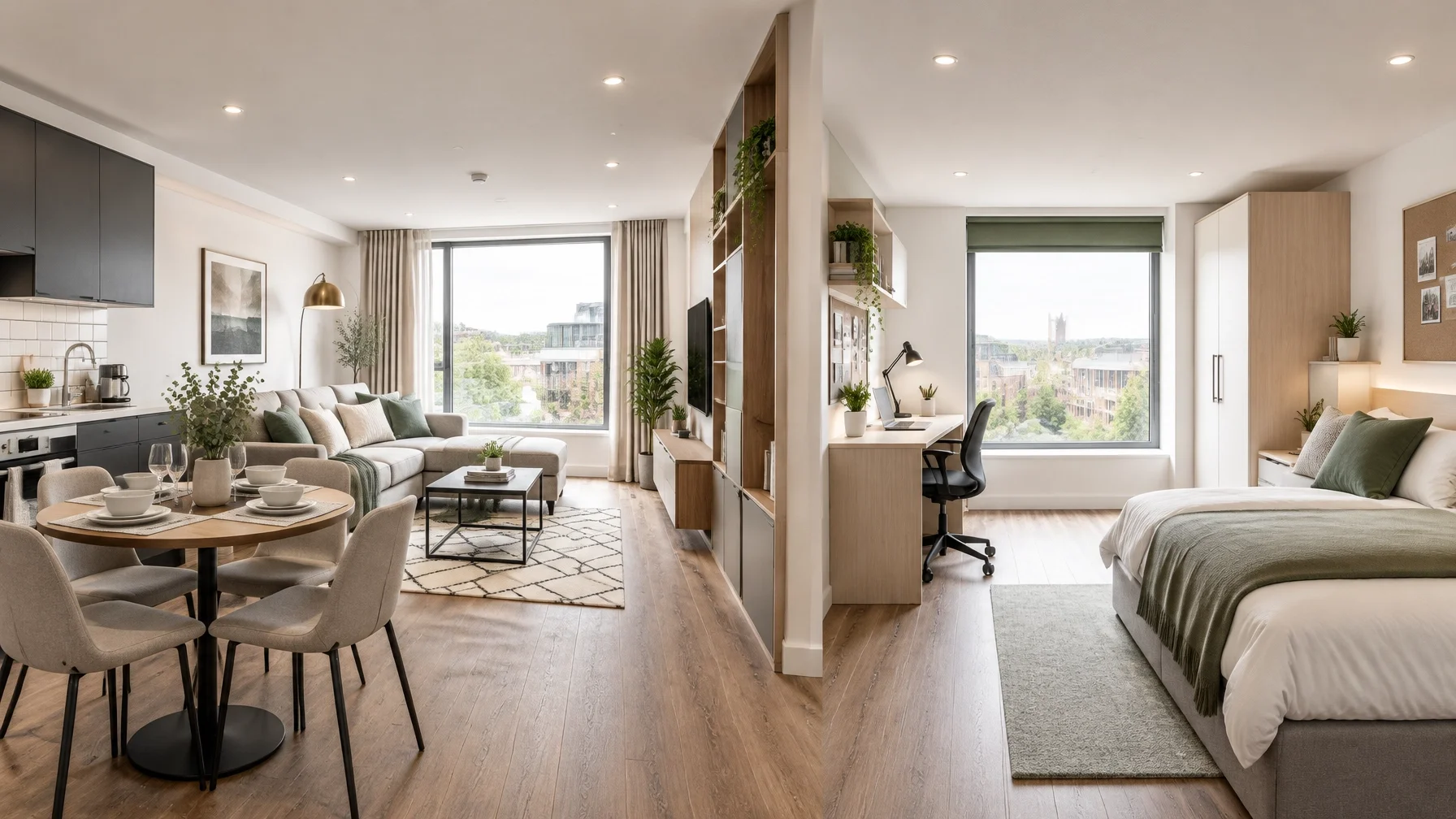
At first glance, aparthotels and purpose-built student accommodation (PBSA) appear to offer a similar proposition. Both can be professionally managed, both may be available within an entry-price range of approximately £50,000 to £100,000, and both allow investors to access property without buying a conventional house or flat.
However, the entry price is where the similarity largely ends.
An aparthotel unit and a PBSA unit are not the same asset class. They serve different occupiers, operate under different planning and letting structures, generate income in different ways and may receive different tax treatment.
For a long-term investor, the crucial question is not simply which unit is cheaper to acquire. It is which operating model provides the most suitable balance of income, flexibility, risk and exit potential.
What each asset actually is
PBSA: purpose-built accommodation for students
PBSA is designed specifically for university students. A typical unit forms part of a professionally operated block, with facilities such as communal areas, study rooms, laundry provision and on-site or central management.
The letting model is generally tied to the academic year. Contracts may run for 44 or 51 weeks, and the occupier is usually required to be a student. Planning conditions, the building’s lease and the operator’s terms may restrict alternative uses.
This creates a relatively clear demand proposition: students require accommodation when they attend university. It can also provide a predictable management structure, particularly where the asset is operated by an established provider.
Nevertheless, the income cycle is concentrated. A 44-week contract may leave an approximately eight-week summer gap, unless the operator can secure summer bookings or other permitted uses.
Aparthotels: hospitality accommodation with a wider customer base
An aparthotel is generally operated as short-stay accommodation, often with self-contained units, kitchenettes or living areas and hotel-style management.
Where the building genuinely operates under C1 use, it is treated for planning purposes as a hotel, guest house or similar establishment. C1 use does not permit permanent residential occupation, which means the asset remains structurally linked to short-stay accommodation rather than becoming a conventional residential tenancy.
Aparthotel units may be let:
Nightly to leisure guests
Weekly to visitors and families
For extended stays to contractors
To corporate travellers
To relocation clients
Around local events, hospitals, universities or major employers
The operational model is therefore more variable, but it is also more flexible. Rather than relying on one annual student cycle, the operator can manage rates and booking length according to demand throughout the year.

Letting options are the clearest difference
This is the strongest argument in favour of comparing aparthotels with PBSA.
A PBSA investment typically has one principal customer segment: students. That is not necessarily a weakness. University demand can be resilient, and the structured academic-year model may suit investors who prioritise simplicity and predictability.
However, the asset’s income is connected to:
University admissions
Student affordability
International student policy
Local competing supply
The academic calendar
The operator’s ability to manage summer occupancy
The unit is not normally available to the wider rental market. A professional, a relocating family or a contractor cannot simply take a PBSA unit under ordinary commercial terms if the building’s planning and lease structure restricts occupation to students.
An aparthotel has a broader potential demand base. A single unit could serve different customer groups at different points in the year:
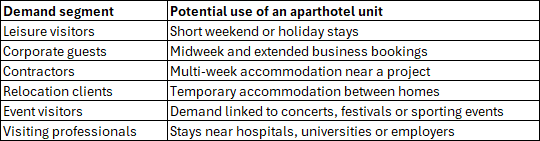
This does not make occupancy automatic. An aparthotel requires appropriate pricing, marketing, housekeeping, guest communication and revenue management. The benefit is that demand is not tied to a single annual intake.
Rates can also be managed dynamically. A city-centre aparthotel may achieve different nightly rates during a major event, a quiet winter week and a contractor booking. PBSA rent is usually agreed through a more standardised tenancy structure.
For an experienced investor, that flexibility can be valuable. It provides more ways to respond when one source of demand weakens.

Tax treatment: potential advantages, but no shortcuts
The tax position is more nuanced than some marketing material suggests.
The former furnished holiday lettings (FHL) regime was abolished with effect from 6 April 2025 for income tax and capital gains tax, and from 1 April 2025 for corporation tax.
This means investors should not rely on the old FHL advantages, including the former capital allowances treatment, more favourable finance-cost rules or certain capital gains reliefs. Any competitor still presenting those benefits as current should be treated cautiously.
Two areas may still create a different outcome for a genuine aparthotel operation.
Capital allowances
A private PBSA unit is often treated similarly to residential accommodation for capital allowances purposes. The ordinary dwelling-house restriction can therefore limit claims.
A genuine aparthotel operated as a commercial hotel-style trade may be in a different position. Depending on the ownership and operating structure, claims may be possible on qualifying plant, machinery and integral features, such as:
Heating systems
Ventilation
Electrical systems
Lighting
Lifts
Certain fixtures and fittings
This is fact-sensitive. Where fixtures are acquired with a property, the previous owner may need to have pooled the expenditure, followed by a joint section 198 election within the relevant timeframe. An investor should not assume that every part of a fit-out qualifies.
SDLT classification
A genuine C1 aparthotel may qualify for non-residential SDLT treatment where the building operates as a hotel or similar establishment, rather than as a collection of dwellings.
Under current non-residential rates, SDLT is charged at:
0% up to £150,000
2% on the portion from £150,001 to £250,000
5% above £250,000
However, the marketing label “aparthotel” is not enough. The services, planning use, lease, management structure and actual operation all matter.
PBSA is also not automatically commercial for SDLT. A transaction-specific review is essential because student accommodation can be treated differently depending on the facts, planning restrictions and statutory dwelling rules.

Running costs: the honest comparison
It would be inaccurate to say that aparthotels are cheaper to run.
Published operating assumptions generally place PBSA costs at approximately 30% to 35% of gross rent, whereas the Residential Estates aparthotel model uses a 37% to 40% cost base against gross revenue.
The honest argument for an aparthotel is not a lower cost ratio. It is that the revenue base can be materially higher, while the model avoids the standard PBSA summer void where the operator cannot fill a 44-week contract.
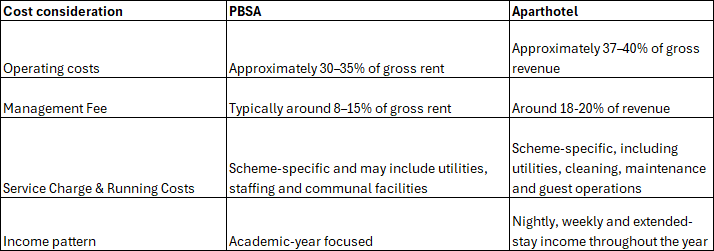
PBSA costs less partly because it provides fewer services and generates less revenue. Aparthotel operations involve cleaning, guest support, utilities, booking channels and more frequent maintenance.
The relevant comparison is therefore net income, not simply the percentage spent on operating costs.
Side-by-side investment comparison
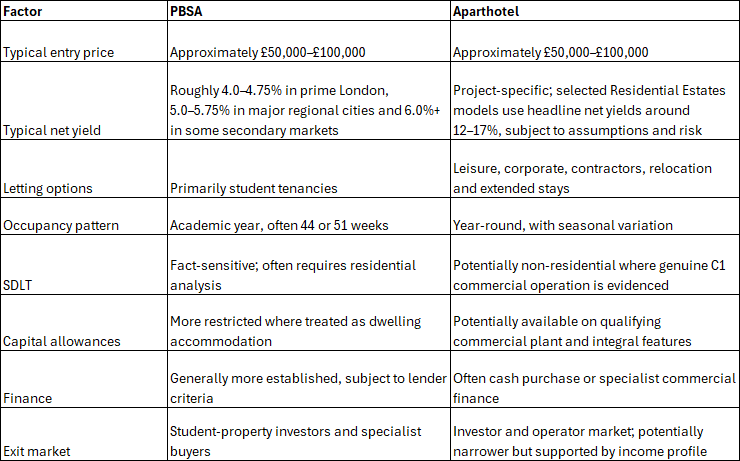
A quoted aparthotel yield must always be checked against its assumptions. The relevant calculation should identify the nightly rate, occupancy, management fee, service charge, running costs, voids, replacement expenditure and tax position.
Which investment model suits whom?
PBSA may suit an investor who values:
A defined student-demand thesis
Professional institutional-style management
A more standardised letting cycle
Potentially lower operating costs
A generally more established finance market
The trade-off is lower flexibility, a narrower occupier base and income concentrated around the university calendar.
An aparthotel may suit an investor who wants:
Higher potential net income
Multiple customer segments
Nightly, weekly and extended-stay options
Dynamic pricing
A potentially more favourable SDLT position
Potential access to commercial capital allowances
Protection from permanent residential occupation where C1 use is genuine
The trade-off is greater operational variability, a higher cost ratio and, in many cases, a cash-only purchase.
Neither model is universally superior. The correct decision depends on the building, operator, location, demand evidence, legal structure and investment horizon.
Frequently asked questions
-
A genuine aparthotel operating under C1 use can be commercial for planning purposes and may qualify for non-residential SDLT treatment. However, “aparthotel” is not automatically a tax classification. The building’s actual use and operation must be confirmed.
-
Possibly, but claims depend on the ownership structure, the nature of the building and the expenditure. Private investor units treated as dwellings may face restrictions. Obtain specialist advice before relying on a claim.
-
They can. A 44-week tenancy may leave an eight-week summer gap unless the operator secures alternative bookings or summer use. A 51-week contract reduces the gap but does not remove wider occupancy risk.
-
Both can be hands-off when managed professionally. PBSA is generally more standardised, while aparthotels require more active operational management behind the scenes. Guestz, powered by Residential Estates, supports the serviced accommodation model through booking, cleaning, guest communication and property management services. Further information is available through the Guestz landlord service.
-
No. A guaranteed rent arrangement is only as strong as the contract, operator and counterparty behind it. Although some off-plan opportunities offer a limited rental guarantee, neither PBSA nor aparthotel income should be treated as risk-free, and projected yields are not guaranteed returns.

Key takeaways
The same £50,000–£100,000 entry price can provide exposure to two very different businesses.
PBSA offers structured demand, professional management and a more predictable academic-year model. Aparthotels offer wider letting options, year-round customer diversification and potentially higher net income.
The aparthotel is not necessarily cheaper to operate. Its advantage is that a higher revenue base can outweigh a higher operating-cost ratio.
The tax position also requires care. The old FHL benefits have ended, but genuine C1 commercial operation may still create a different SDLT and capital allowances analysis.
This article was last reviewed in October 2026. SDLT, capital allowances, planning and short-term letting rules may change, particularly following the Autumn Budget on 28 October 2026. Always obtain professional advice on the specific asset before committing funds.
If you would like to compare available PBSA and aparthotel opportunities on a no-obligation basis, contact Residential Estates on 01244 343 355 or email sales@residential-estates.co.uk. You can also review our wider aparthotel investment model and serviced accommodation analysis before arranging a discussion.
This article is for general information only. Property values, occupancy, income and yields can fall as well as rise. Past performance and projected returns are not guarantees of future results, and investors may not recover the amount originally invested.
Residential Estates is not FCA approved and cannot provide tax or financial advice. Investors should consult an appropriately qualified tax adviser, solicitor and financial adviser.