
Airbnb vs Buy-to-Let: Which Property Investment Model Makes Sense in Today’s Market?

For decades, Buy-to-Let (BTL) has been the default route into property investment. It’s familiar, widely understood, and traditionally viewed as stable.
But over the last ten years, another model has moved firmly into the mainstream: Airbnb-style short-term letting.
Once seen as a side hustle for homeowners, Airbnb has evolved into a professional, scalable investment model used by investors, developers, and institutional operators alike.
So how do the two models really compare?
This article breaks down Airbnb vs Buy-to-Let across income, risk, regulation, management, and suitability — helping investors understand which approach best aligns with their goals.
1. Understanding the Two Models
Buy-to-Let (BTL)
Buy-to-Let involves purchasing a property and renting it to a long-term tenant, typically on a 6–12 month Assured Shorthold Tenancy (AST).
Income is fixed, predictable, and usually paid monthly. The focus is often split between rental yield and long-term capital growth.
Airbnb / Short-Term Let Model
The Airbnb model involves letting a property on a short-term basis, often nightly or weekly, to a mix of leisure, business, and relocation guests.
Despite the name, this model extends beyond Airbnb itself and includes: - Serviced accommodation - Corporate short stays - Contractor and relocation lets
The key distinction is flexibility and pricing power, rather than fixed monthly rent.
2. Income Potential: Fixed vs Flexible
Buy-to-Let Income
BTL income is straightforward: - Fixed monthly rent - Limited ability to increase income during the tenancy - Voids between tenants reduce annual yield
While stable, income growth is often slow and constrained by market rents and affordability.
Airbnb Income
Airbnb income is generated on a per-night basis, allowing: - Dynamic pricing based on demand - Higher rates during peak periods - The ability to optimise revenue through professional pricing tools
In strong locations, Airbnb properties often generate higher gross income than Buy-to-Let — although income may fluctuate month to month.
3. Demand Drivers
Buy-to-Let Demand
BTL demand is driven by: - Local employment - Affordability constraints - Long-term housing shortages
While demand remains strong in many areas, landlords increasingly face tenant affordability limits and rising regulation.
Airbnb Demand
Airbnb demand is far more diverse, including: - Business travellers - Contractors and consultants - Families and leisure guests - Insurance and relocation stays
This diversity means income isn’t reliant on a single tenant profile.

4. Management & Involvement
Buy-to-Let Management
BTL can be: - Self-managed - Agent-managed (typically 8–12% of rent)
However, landlords still retain responsibility for: - Maintenance - Compliance - Tenant issues - Void periods
Airbnb Management
Airbnb is often perceived as management-heavy — but this depends on structure.
Many investors now use: - Professional short-term let operators - Fully managed, hands-off solutions - End-to-end services covering pricing, cleaning, and guest communication
When professionally managed, Airbnb can be less time-intensive than Buy-to-Let.
5. Regulation & Risk
Buy-to-Let Risks
BTL investors face increasing regulation, including: - Section 24 mortgage interest restrictions - EPC requirements - Rent controls in some regions - Eviction and tenant protection legislation
These factors have compressed margins for many landlords.
Airbnb Risks
Airbnb risks tend to centre around: - Local planning and licensing rules - Lease restrictions - Seasonal demand
These risks are mitigated through careful property selection, compliant leases, and diversified guest strategies.
Importantly, regulation varies widely by location — making due diligence essential.
6. Flexibility & Exit Strategy
Buy-to-Let
BTL offers: - Limited flexibility during tenancies - Fixed use of the property
Selling may require vacant possession, which can delay exit.
Airbnb
Airbnb provides greater flexibility: - Switch between short and medium stays - Personal use if required - Ability to pivot strategy as markets change
This adaptability is a major advantage in uncertain economic conditions.
7. Who Each Model Is Best Suited For
Buy-to-Let May Suit Investors Who:
· Prioritise predictability over income growth
· Prefer long-term tenants
· Are comfortable with regulation-heavy environments
· Focus primarily on capital appreciation
Airbnb May Suit Investors Who:
Want higher income potential
Are open to flexible pricing models
Prefer diversified demand
Use professional management
Focus on income rather than just growth
8. The Bigger Picture
The rise of Airbnb doesn’t mean Buy-to-Let is obsolete — but it does mean the investment landscape has changed.
Rising regulation, tax pressure, and affordability challenges have made traditional Buy-to-Let less attractive for some investors.
At the same time, Airbnb-style short-term letting has matured into a professional, data-driven asset class, particularly when paired with experienced operators.
Airbnb and Buy-to-Let are not opposing models — they are tools.
The right choice depends on:
Your income goals
Risk tolerance
Time involvement preferences
Location and property type
For many modern investors, the question is no longer “Buy-to-Let or Airbnb?” — but how to structure property investments intelligently in a changing market.
If you’re exploring property investment options and want clarity on which model suits your goals, speaking to a specialist can make all the difference.
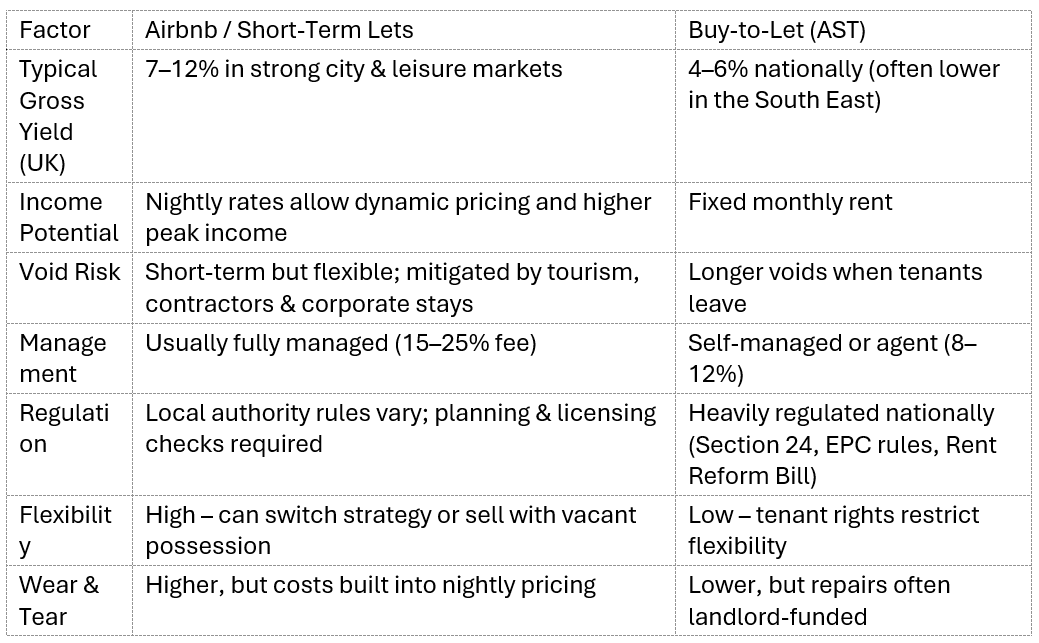
Airbnb vs Buy-to-Let: A Side-by-Side Comparison
Below is a high-level comparison based on typical UK market conditions. Actual performance will vary by location, property type, and management quality.
Regulation and Compliance Considerations
Airbnb / Short-Term Lets (UK)
Airbnb-style investments are legal across much of the UK, but regulation is increasingly localised rather than national.
Key considerations include: - Planning use class and local authority short-let policies - Article 4 Directions in some city centres - Potential licensing schemes (e.g. Scotland, selective English councils) - Compliance with fire safety, insurance, and health & safety standards
When structured correctly — with the right property, lease permissions, and professional management — Airbnb investments remain fully compliant and scalable.
Buy-to-Let (AST)
Buy-to-Let investors face national regulation, including: - Section 24 mortgage interest relief restrictions - EPC minimum standards (moving toward EPC C) - The proposed Renters Reform Bill - Increased tenant protections and longer eviction timelines
These changes have compressed net yields and reduced flexibility for many landlords.

Final Thoughts
The debate between Airbnb and Buy-to-Let is no longer about which model is ‘better’ — it’s about which model fits the modern investor.
Buy-to-Let still has a place for those seeking simplicity and long-term capital preservation, particularly in lower-value regional markets. However, rising regulation, tax changes, and capped income growth have made it far less attractive than it once was.
Airbnb-led investments, when executed properly, reflect how the property market has evolved: - Shorter stays but higher-quality guests - Flexible pricing in line with demand - Professional, hospitality-style management - Multiple demand drivers (tourism, business travel, relocations)
For investors willing to prioritise location, structure, and professional oversight, the Airbnb model offers stronger income potential, greater flexibility, and better alignment with modern living and travel trends.
A Note on Strategy
The most successful investors don’t choose a model blindly — they choose the right model for the right asset. Not every property suits Airbnb, just as not every property works as a long-term rental.
That’s where expert guidance matters.
Considering an Airbnb model Investment?
We specialise in identifying and structuring Airbnb and short-term let investments that are:
Fully compliant
Professionally managed
Located in proven, high-demand areas
If you’d like to explore whether an Airbnb-led strategy fits your investment goals, we’re happy to have a no-obligation conversation.
👉 Speak to us about Airbnb-led investments
Ready to Learn More?
Why not talk to one of our experienced Property Investment Consultants?
Whether you're looking to expand your portfolio or make your first investment, we make the process effortless. With expert guidance, a hands-off management approach, and access to high-demand rental markets, Residential Estates provides everything you need to succeed in property investment.
Get in touch today to explore our latest opportunities and start building a profitable, stress-free property portfolio.