
2026 Stamp Duty Guide: Calculating Costs for New Investors

For many entering the realm of property investment in 2026, the prevailing narrative in mainstream media has often been one of "taxation hurdles" and "diminishing returns." Sensationalist headlines frequently focus on the immediate cost of entry, overlooking the fundamental resilience that the UK property market continues to demonstrate. While recent fiscal adjustments, notably the 5% surcharge on additional properties, require a more nuanced approach to financial planning, they by no means precipitate an end to profitable investment.
In this guide, we will move beyond the reactive "doom-mongering" and take a measured, analytical look at the 2026 Stamp Duty Land Tax (SDLT) landscape. By understanding the data and historical context, serious investors can reassert their confidence and integrate these costs into a robust, long-term strategy.
The 2026 SDLT Landscape: A Rational Breakdown
The Stamp Duty environment in 2026 is defined by the recalibrations introduced in the 2024 and 2025 budgets. To the uninitiated, the 5% surcharge on additional residential properties might seem like an unpalatable barrier. However, when viewed through a long-term lens, it is simply a known variable: a professional cost of doing business in a high-demand asset class.
For investment property in the UK, the effective rates for additional properties (those where the owner already holds a residential interest) are structured across tiered bands. Since 1 April 2025, the thresholds have reverted to their historical norms, making it essential to use a precise stamp duty calculator 2026 for your ROI projections.
Effective SDLT Rates for Additional Properties in 2026
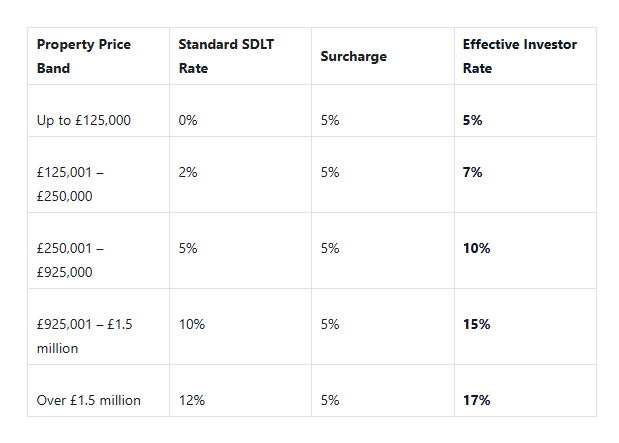
While a 10% tax on the portion of a property between £250,001 and £925,000 represents a significant initial outlay, it is important to remember that tax policy is often cyclical. For the experienced professional, the focus remains on capital appreciation and rental yield over a decade or more, where these entry costs are steadily amortised.
Concession and Pivot: Managing the "Surcharge Shock"
It is a fair concession to admit that an increased upfront tax burden affects initial liquidity. Nevertheless, this fiscal tightening often serves as a filter, cooling speculative "house flipping" and leaving the market to dedicated, long-term investors. This reduced volatility is a net positive for those seeking stable, predictable growth.
Furthermore, current rates are manageable when compared to historical peaks in borrowing costs and other property-related levies. The underlying strength of the UK market: driven by a persistent disparity between housing supply and a growing population: ensures that well-selected assets continue to outperform more volatile investment vehicles.

Integrating SDLT into Your ROI Calculations
Calculating your return on investment requires more than just looking at the purchase price. A sophisticated investor treats SDLT as a capital expense that influences the "break-even" point.
Consider an investment property purchased for £300,000 in 2026:
First £125,000 at 5%: £6,250
Next £125,000 at 7%: £8,750
Final £50,000 at 10%: £5,000
Total SDLT Liability: £20,000
While £20,000 is a tangible figure, it represents just 6.6% of the total asset value. In many high-growth UK hubs, annual capital appreciation has historically exceeded this percentage, meaning the tax burden can effectively be "recovered" through market growth within 12 to 24 months of ownership.
At Residential Estates, we assist our clients in identifying these high-performance areas. You can explore our latest insights on investor confidence to see how professionals are currently navigating these changes.
Why the UK Market Remains Resilient
The popular narrative often fails to account for the "flight to quality." As taxation becomes more complex, the value of professional guidance and high-specification properties increases.
Supply-Demand Mismatch: The fundamental shortage of quality housing in the UK remains the most significant driver of value.
Rental Growth: With more potential buyers remaining in the rental sector due to stricter mortgage criteria, rental yields in key cities remain robust.
Stability: Compared to the volatility of equity markets or cryptocurrency, UK real estate offers a tangible, resilient asset that institutional and private investors alike continue to favour.

Strategic Financial Planning with Residential Estates
Navigating the intricacies of the stamp duty calculator 2026 is only one part of the journey. To truly maximise returns, investors must look at the complete property cycle. This is where a partnership with a comprehensive service provider becomes invaluable.
At Residential Estates, we don't just find you a property; we manage the entire lifecycle: from the initial investment and financial feasibility studies to long-term and short-term management. Our decades of experience allow us to see through the temporary noise of budget updates and focus on the sustainable trends that build generational wealth.
Whether you are looking at Purpose-Built Student Accommodation (PBSA) or high-yield serviced apartments, understanding your tax obligations is the first step toward a rational, clinical investment decision.
Conclusion: Reasserting Stability
The 2026 Stamp Duty changes are not a "crisis," but a "readjustment." By moving away from sensationalist headlines and toward data-driven analysis, investors can see that the UK property market remains a pillar of stability. The 5% surcharge is a manageable factor for those who view property as a long-term vehicle for capital growth and income.
As we move further into the year, the disparity between those who act on data and those who wait on the sidelines will only grow. Success in property investment belongs to those who prepare for the nuances of the tax system rather than fearing them.
For a detailed consultation on how to optimise your 2026 portfolio and account for the latest SDLT rates, contact our expert team today.
Ready to Learn More?
Why not talk to one of our experienced Property Investment Consultants?
Whether you're looking to expand your portfolio or make your first investment, we make the process effortless. With expert guidance, a hands-off management approach, and access to high-demand rental markets, Residential Estates provides everything you need to succeed in property investment.
Get in touch today to explore our latest opportunities and start building a profitable, stress-free property portfolio.